

U.S. FDA Center for Tobacco Products (CTP) Releases 2024 Annual Review of Regulatory Progress
Leave a message
U.S. FDA Center for Tobacco Products (CTP) Releases 2024 Annual Review of Regulatory Progress
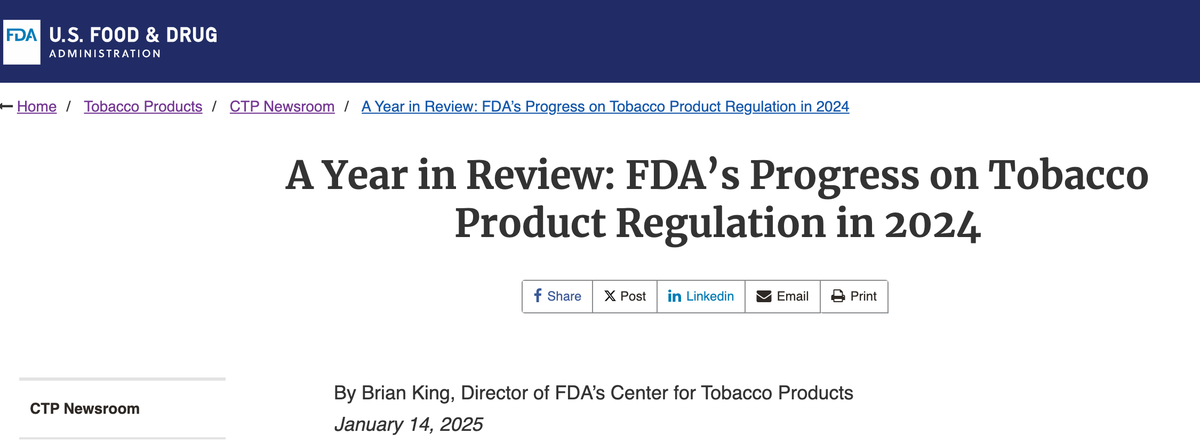
The director of the U.S. FDA Tobacco Center published an article reviewing the regulatory progress in 2024, summarizing the core work of the previous year from the aspects of achievements, law enforcement, supervision, public education, etc.
On January 14, 2025, the U.S. Food and Drug Administration (FDA) Center for Tobacco Products (CTP) published the article "A Year in Review: Progress of the U.S. Food and Drug Administration in Tobacco Product Regulation in 2024". The article is signed by Brian King, Director of CTP. This article reviews the annual work and achievements of CTP in tobacco regulation in 2024 from the perspective of year-end summary.
Main achievements:
1. Decline in youth tobacco use: The use of tobacco products by American youth has dropped to the lowest level in 25 years. In the past five years, the use of e-cigarettes by middle school and high school students has decreased by nearly 70%.
2. Smoking rates hit a record low: Since 2009, the smoking rate of adults has been reduced by half. In 2024, only 1.4% of middle school and high school students reported using cigarettes.
Compliance and Enforcement:
1. Strengthened Enforcement: CTP has strengthened compliance monitoring and enforcement actions in the tobacco product supply chain, focusing on collaboration with federal partners.
2. Multi-department Joint Task Force: In June 2024, the FDA and the U.S. Department of Justice jointly established a federal task force focused on combating the distribution and sale of unauthorized e-cigarettes.
3. Major Seizures: In October 2024, a joint operation with the U.S. Customs and Border Protection (CBP) seized $76 million worth of unauthorized e-cigarettes, including brands that appeal to teenagers such as Geek Bar.
4. Diversified Enforcement Methods: The FDA has adopted a variety of enforcement methods, including warning letters and civil penalty complaints. In 2024, the FDA issued warning letters to 50 manufacturers, distributors, and more than 430 retailers.
Regulatory Progress:
1. Product Standards: CTP has promoted product standards that prohibit menthol in cigarettes and all characteristic flavors in cigars.
2. Strategic Planning: A new five-year strategic plan was released in December 2023, which clearly defines the goals of strengthening compliance supervision and protecting public health.
Public Education and Research:
1. PATH research continues to advance: The Population Tobacco and Health Assessment Study (PATH), in collaboration with the National Institute on Drug Abuse, provides important data on tobacco use behaviors.
2. Public Engagement: CTP held several public meetings and webinars to educate stakeholders on the regulatory process and compliance.
CTP Director Brian King emphasized that a "whole-of-government" collaborative approach was essential to achieving these milestones and reaffirmed the commitment to protecting public health through science-based regulation.
At the end of 2024, the two supremes published an article to review the FDA's 2024 e-cigarette supervision work:
US FDA e-cigarette law enforcement review throughout the year: full-chain and multi-style law enforcement, focusing on Kikner and Love Miracle
FDA also explained the relevant regulatory actions to the two supremes 2Firsts:
FDA explained recent regulatory actions to 2Firsts: full-chain supervision will promptly introduce policies to adapt to market changes
Entering 2025, CTP has issued several announcements in succession, such as:
US law enforcement agencies seized more than $7 million worth of illegal e-cigarettes, and the FDA emphasized that law enforcement actions will continue to advance
US FDA issued the final version of the guidelines for tobacco product analysis and testing methods to standardize the market access process
US FDA updated import alerts: All unauthorized e-cigarettes may be seized without physical inspection
The following is the full text of this FDA announcement (Chinese translation by the two supremes, for reference only. Please refer to the original English text.)
"Looking back on the year: FDA's progress in tobacco product regulation in 2024"
Author: Brian King, Director of the FDA's Center for Tobacco Products
Date: January 14, 2025
As we enter the new year, the FDA's Center for Tobacco Products (CTP) continues its efforts to protect the American public from tobacco-related disease and death. At the same time, we celebrate significant public health victories from the past year, including the decline in current tobacco product use among U.S. youth to the lowest level in the past 25 years. This historic decline is driven primarily by significant reductions in e-cigarette use among youth; current e-cigarette use among U.S. middle and high school students has dropped nearly 70 percent over the past five years, with fewer than 500,000 youth reporting use of these products in the past year alone.
In addition, smoking rates-the deadliest form of tobacco product use-are at an all-time low. U.S. adult cigarette smoking rates are about half of what they were in 2009, when the FDA first gained authority to regulate tobacco products. In addition, in 2024, only 1.4 percent of U.S. middle and high school students will report current cigarette use.
These advances are the result of a concerted effort across the CTP, which is guided by our Strategic Plan and spans multiple program areas. These efforts include strengthening compliance and enforcement actions across the supply chain, reviewing applications for new tobacco products before they can be legally marketed, developing regulations and guidance, and educating the public about the risks of tobacco products. Additional details and examples of these actions over the past year are described below.
Strengthening Compliance and Enforcement Actions Across the Supply Chain
Compliance and enforcement actions across the tobacco product supply chain continue to be a top priority for the CTP. Progress has been made in taking escalated enforcement and compliance actions. But we can't do this alone; a "whole-of-government" approach is needed, including support from federal partners. To that end, in June 2024, FDA and the U.S. Department of Justice announced the formation of a federal multi-agency task force focused on curbing the distribution and sale of unauthorized e-cigarettes. The task force meets regularly and acts quickly.
In October 2024, FDA and U.S. Customs and Border Protection (CBP) - partners in the task force - announced a joint federal operation that seized $76 million worth of unauthorized e-cigarettes, including popular, youth-appealing, foreign-owned brands such as Geek Bar. This action is just one of several ongoing enforcement actions by federal agencies-which have increased in frequency with the creation of the task force-to address the issue of unauthorized e-cigarettes.
In April 2024, the FDA coordinated with the U.S. Department of Justice for the first time, announcing that the U.S. Marshals Service had seized more than $700,000 worth of unauthorized e-cigarettes at a warehouse in California.
In addition, the agency took numerous compliance and enforcement actions in 2024 against unauthorized tobacco products, particularly those that most appeal to youth. For example, the Center issued warning letters to more than 50 manufacturers and distributors and more than 430 retailers, bringing the total number of warning letters to more than 710 for manufacturers and distributors and more than 800 for retailers. CTP also filed an unprecedented number of civil penalty complaints for unauthorized products in the past year: 44 against manufacturers and more than 100 against retailers, bringing the total number of manufacturers to 80 and the total number of retailers to 175.
CTP remains committed to using the full range of tools in the regulatory toolbox-coordinating with federal partners using its unique authorities-to ensure that those who manufacture, distribute, or sell illegal tobacco products are held accountable under the law.
Rigorous Science-Based Premarket Review Process
The premarket review process remains a cornerstone of CTP's work, and CTP continues to issue decisions and provide information to help those who submit applications. A rigorous science-based approach is critical to this process. Following this approach, in 2024, the Center issued several market authorization orders, including the first authorization of a non-tobacco flavored e-cigarette product as well as a tobacco-flavored e-cigarette product. The agency also issued modified risk authorization orders for eight generic snus products.
At the same time, CTP issued market denial orders for those who failed to meet the public health standards required by the law, including issuing market denial orders for more than 65,000 non-tobacco flavored e-cigarette product applications. Through these decisions, the Center has processed more than 26 million applications, including 99.5% of e-cigarette products with a high market share.
In addition to these scientific reviews, CTP remains committed to ensuring clear communication and transparency about the tobacco product review process and market decisions. For example, in April 2024, CTP resumed issuing scientific review policy memoranda on certain topics in the premarket tobacco review process. In 2024, CTP issued 26 policy memoranda, including chemistry and toxicology, providing a snapshot of FDA's internal thinking on these topics.
In addition, in March 2024, CTP launched the Searchable Tobacco Products Database, a user-friendly list of tobacco products-including e-cigarettes-that can legally be sold in the U.S. market. In the new year, CTP plans to continue to optimize the upcoming CTP Portal Next Generation, an improved web portal for submitting applications for certain new tobacco products.
Issuing Rules and Guidances to Protect Public Health
As a regulator, one of the key ways FDA makes progress is by issuing rules that establish certain requirements for those who manufacture and sell tobacco products. For example, in August 2024, FDA issued a Tobacco 21 Final Rule to further keep tobacco products out of the hands of teens and young adults. The rule requires retailers to confirm the age of anyone under 30 who attempts to purchase tobacco products, including e-cigarettes, through photo identity verification. The rule also prevents retailers from selling tobacco products through vending machines in any facility where anyone under 21 has access or is permitted access.
In 2024, FDA and the Treasury Department also announced a proposed rule requiring importers to enter the submission tracking number of FDA-issued e-cigarette marketing applications into the electronic import system operated by U.S. Customs and Border Protection. This new requirement will help streamline the process for reviewing the admissibility of e-cigarette products into the United States.
Educating the public about the risks of tobacco products
Educating the public, especially youth, about the risks of using tobacco products is a key part of FDA's public health mission. Given that most adult tobacco product use begins during adolescence, CTPs can bring lasting, cost-saving health improvements to the nation by preventing youth from using tobacco products in the first place. For example, in 2024, FDA's award-winning "The True Cost" youth tobacco prevention campaign marked 10 years of communicating key tobacco product prevention messages to youth. Over the past year, the agency has released new ads, including one that focuses on the health effects and social consequences of youth e-cigarette use.
In addition, CTPs have prioritized research efforts over the past year to inform public education opportunities for adult smokers. For example, CTP and the National Institutes of Health (NIH) awarded funding to study how best to accurately communicate the relative risks of tobacco products to adults who smoke, while ensuring that this information does not appeal to other audiences, including adolescents. The Center is also educating the public on this issue in other ways. CTP launched a new web resource designed to communicate the relative risks of tobacco products to the public. To further communicate these ideas, I co-authored a review article published in the journal Nature Medicine that suggests opportunities exist to educate adults who smoke about the relative risks of tobacco products, including e-cigarettes.
CTP also continues to educate the public on the benefits of quitting smoking. CTP continues to work with federal partners at the National Cancer Institute to provide information on smoking cessation and other tobacco health resources through Smokefree.gov, which offers materials tailored to meet an individual's needs. CTP also recently expanded its suite of adult smoking cessation education materials to include 15 new posters targeted at additional audiences. These posters are available at CTP's conference exhibit booth as the year comes to a close and will be available to the public through CTP's Tobacco Education Resource Library in 2025.
Looking Ahead
Significant progress was made over the past year, but further success must also be complemented by adequate resources. The law provides sweeping authority for tobacco regulation; however, given the size and dynamic nature of the market, challenges increase when resources fail to keep pace with the workload. FDA's tobacco budget has remained flat over the past five years, which will continue to present challenges for the important work ahead.
It is also critical for FDA to continue to meaningfully engage with the public. Our engagement with stakeholders over the past year has been informative and productive-including leadership speaking at conferences, holding hearings to hear from stakeholders, and participating in more than 25 meetings. CTP values engagement with the public and is committed to continuing these efforts in 2025. Continued transparency and communication are also critical-the Center remains committed to communicating with stakeholders through multiple means to ensure that information about the Center's activities is timely, accurate, and relevant.
Our future is bright as we continue to move toward 2025, and I look forward to welcoming the new year with our stakeholders. CTP remains committed to our mission to protect the American public from the health threats of tobacco-related death and disease.


