Shenzhen's smoking rate is lower than that of Beijing and Shanghai, achieving the 2030 Healthy China Action tobacco control goals ahead of schedule
Leave a message
Shenzhen's smoking rate is lower than that of Beijing and Shanghai, achieving the 2030 Healthy China Action tobacco control goals ahead of schedule
In 2023, as a key indicator for testing the results of tobacco control, the smoking rate of adults aged 15 and above in Shenzhen will drop to 16.9%, which is lower than Beijing (19.9% in 2023), Shanghai (19.4% in 2023), and the national value in 2022 (24.1 %), achieving the 2030 tobacco control goals of the Healthy China Action ahead of schedule.
In 2024, Shenzhen will usher in a milestone moment in tobacco control, marking the tenth anniversary of the implementation of the 2014 version of the "Shenzhen Special Economic Zone Smoking Control Regulations."
The survey shows that Shenzhen's key tobacco control indicator (adults aged 15 and above) smoking rate has dropped to 16.9%, which is lower than Beijing (19.9% in 2023), Shanghai (19.4% in 2023), and lower than the national average in 2022 24.1%, achieving the 2030 tobacco control goal of the Healthy China Action ahead of schedule.
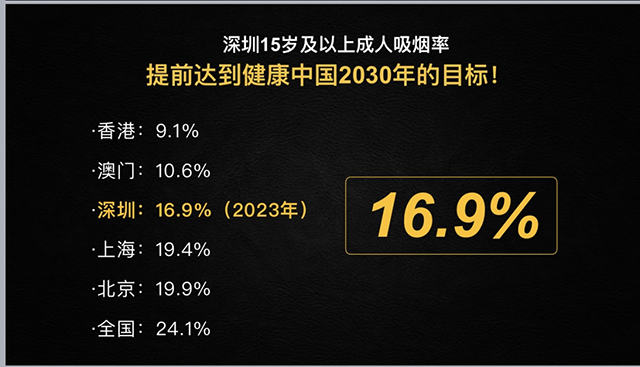
The smoking rate among adults aged 15 and above in Shenzhen has dropped to 16.9%
01. Mainland China has the strictest "smoking control order", and WHO representatives called it a "model"
On March 1, 2014, the "Shenzhen Special Economic Zone Regulations on Smoking Control" (hereinafter referred to as the "Regulations") came into effect.
The "Regulations" are a "comprehensive smoke-free" regulation, that is, all indoor public places, workplaces, and public transportation are completely smoke-free, marking the official launch of comprehensive tobacco control in Shenzhen.
The "Regulations" innovatively established a joint tobacco control system that "levers the power of the whole city", led by the health administrative department. 23 units formed a joint tobacco control meeting, and 8 units jointly enforced the law. At the same time, a team of tobacco control volunteers was established to mobilize the whole society to participate. , providing reference experience for promoting "health integration into all policies".

Since then, in 2019, the "Regulations" were revised again, including bus stations, subway entrances and exits, and e-cigarettes as smoking bans, which can be called the strictest "smoking control order" in mainland China.
Martin Taylor, the representative of the World Health Organization in China, praised the Regulations as a legal model because it fully complies with the requirements of Article 8 of the World Health Organization's Framework Treaty on Tobacco Control. The revised version further demonstrates that Shenzhen keeps pace with the times. spirit, providing stronger protection for the public.
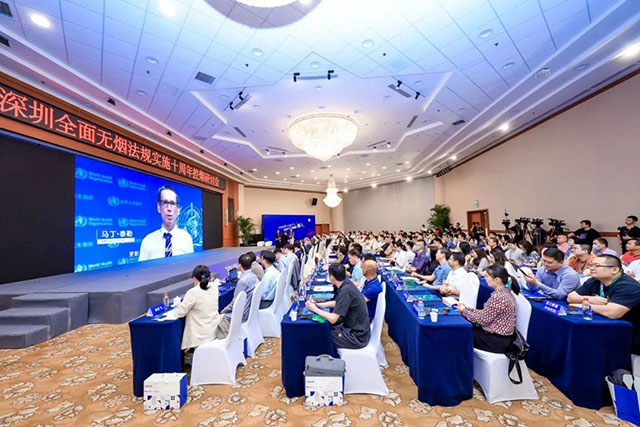
02. 8 units jointly enforced law, creating many "mainland firsts"
Since 2017, Shenzhen has pioneered the "wheel war" of tobacco control law enforcement, which involves no greetings, surprise operations, media tracking and reporting, and live broadcast of the entire process. So far, a total of 31 rounds and 183 games have been carried out, creating a tobacco control brand that is spread by word of mouth among citizens.
After ten years of tobacco control, Shenzhen has fined more than 8.75 million yuan, leading the country in both the intensity of penalties and the effectiveness of law enforcement. Among them, 8 law enforcement units dispatched a total of 1.868 million law enforcement personnel; 1.984 million people were discouraged from smoking, 153,000 individuals were punished for illegal smoking, and a total of 7.704 million yuan in fines were imposed on individuals; 1.096 million places of various types were supervised and inspected, and 8,849 places were inspected. Administrative penalties of warnings were given to places that violated laws and regulations, and 53,000 supervisory opinions were issued. 146 administrative penalties were imposed on places that violated laws and regulations, with a total fine of 1.05 million yuan.
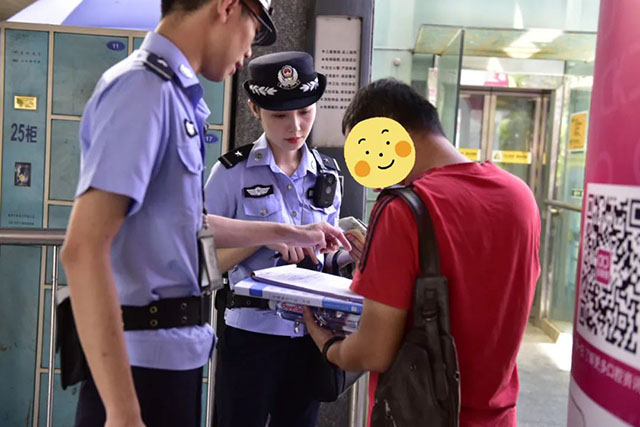
In the past ten years, Shenzhen's tobacco control law enforcement has set many domestic "firsts": the first 30,000 yuan fine for selling cigarettes to minors, the first 30,000 yuan fine for poor Internet cafes to control tobacco, and the first 30,000 yuan fine for illegal smokers running away. 500 yuan fine, the first fine for illegal smoking of e-cigarettes, the first fine for a physical e-cigarette store, the first time that e-cigarettes were added to the no-smoking sign, and the first pilot installation of "electronic eyes" for smoking control.
Among them, the country's first tobacco control "electronic eye" is empowered by technology to achieve precise law enforcement. The "electronic eye" for smoking control was first piloted in Maluan Street, Pingshan District, Shenzhen City. It is installed in no-smoking areas such as restaurants, stations, and Internet cafes. It updates air data every 3 seconds. When the smell of smoke is strong, it will automatically alarm and transmit it to the background in real time for law enforcement. Officers check clues on their mobile phones and conduct door-to-door investigations.
In 2023, Shenzhen also launched the "Stop Smoking" tobacco control complaint applet. Citizens can scan the code to upload photos and complain about illegal smoking. After the system receives each complaint and passes the review, volunteers from each street will be automatically assigned to go to the site for verification, supervision, and publicity and education. Law enforcement departments will also follow up.
Currently, there are 6,732 tobacco control volunteers who have registered on the "Stop Smoking" tobacco control mini program, received training, and passed assessment and certification. They have served a total of 54,995 hours, volunteered for more than 39,000 people, and supervised more than 15,000 tobacco control sites. At present, the "Don't smoke" mini program has handled nearly 15,000 complaints.