GTNF Online Conference: Using science to fight the horror narrative of nicotine and its harms
Leave a message
GTNF Online Conference: Using science to fight the "horror narrative of nicotine and its harms"
The Global Tobacco and Nicotine Forum (GTNF) held an online forum InFocus 2024 Nicotine. The forum revolved around two core themes: "Myths about Nicotine and Its Harm" and "Nicotine Industry from an Agricultural Perspective". 2FIRSTS participated in the meeting as an invited media and reported on it.
Recently, the Global Tobacco and Nicotine Forum (GTNF) held an online forum InFocus 2024 Nicotine. The forum revolved around two core themes: "Myths about Nicotine and Its Harm" and "Nicotine Industry from an Agricultural Perspective". 2FIRSTS participated in the meeting as an invited media and reported on it.
The forum began with a welcome speech by Elise Rasmussen, founder of GTNF and executive director of the GTNF Trust Fund. In his speech, Rasmussen pointed out that since the end of last year, the new tobacco policies in the UK and the US have been erratic, highlighting the uncertainty of global nicotine regulation. He also expressed gratitude to the guests who participated in the forum and thanked these industry experts for sharing their professional insights.
Breaking the misconception that e-cigarettes are "more harmful"
Michael Strupp, professor of neurology at the Medical School of Ludwig-Maximilian University of Munich, gave the first keynote speech of this forum. The content revolved around the pathological characteristics of nicotine and synthetic nicotine, and explained in detail the molecular structure, receptors and anatomical process of nicotine absorption by the human body.
In his speech, Professor Strupp reiterated his important argument: nicotine is a molecular structure and is not carcinogenic in itself. Finally, he vividly compared the relationship between e-cigarettes and traditional combustible cigarettes to "fuel vehicles and electric vehicles", saying that the underlying logic of e-cigarettes is similar to the advantages of electric vehicles, that is, "cleaner processes and less losses."

After Professor Stroop's speech, James Murphy, Director of Research and Science at British American Tobacco (BAT), delivered a keynote speech. He was previously Group Head of Science for Harm Reduction Products (PRRP) and Product Manager for the Americas and Sub-Saharan Africa. Based on his experience in these developing markets, he proposed that "the public health community needs to take a consistent scientific view on the new generation of tobacco products" in order to provide regulators around the world with the right information to form a "stable framework."
In his keynote speech, Murphy shared his personal experience and said that the dual topics set by this forum have the dual significance of "promoting public health" and "focusing on social welfare."

The first special forum then invited a number of industry guests to have a deeper discussion on the misunderstandings and myths about nicotine and e-cigarettes. The seminar was hosted by Jasjit Ahluwalia, professor of behavioral and social sciences and professor of medicine at the Brown University School of Public Health and Alpert Medical School, and the guests included family physician and chairman of the "Health Diplomats" group Delon Human, former chief operating officer of the American Legal Foundation/Truth Initiative Dave Dobbins, and nicotine expert and health technology entrepreneur Sudhanshu Patwardhan.

The first special forum further discussed the misunderstandings and myths about nicotine and e-cigarettes | Source: GTNF
Aluwalia specifically pointed out that in the past decade when the e-cigarette market began to grow, the saying that "e-cigarettes are more harmful than traditional combustible cigarettes" has gradually become popular among smokers, and many nicotine users who originally turned to e-cigarettes have returned to cigarettes. After discussion, the guests agreed that the industry should invest more resources in relevant research and use science to fight the "terrorist narrative."
Dobbins, on the other hand, stood from the perspective of the market, starting from human rights and legal principles. He talked about the correct direction of social regulation of nicotine products. He mentioned that every behavior and choice of adults is made by themselves and they are responsible for themselves, so "adults need to be treated as adults. Instead of using flavor bans or even a complete ban to manage (nicotine intake methods) this matter."
Nicotine from an agricultural perspective: protecting the interests of farmers
The second seminar of this forum focused on a sector that is rarely paid attention to by industry insiders: the upstream tobacco agriculture of the nicotine industry and the welfare of related farmers. The second workshop was attended by George Cassels-Smith, CEO of Tobacco Technology, Ramsey S. Lewis, Charles and Marilyn Stuber Professor of Plant Breeding at North Carolina State University, Carlos Pulcinelli, global project manager at Alliance One International, and Lea Scott, senior vice president of Universal Leaf Tobacco Co.
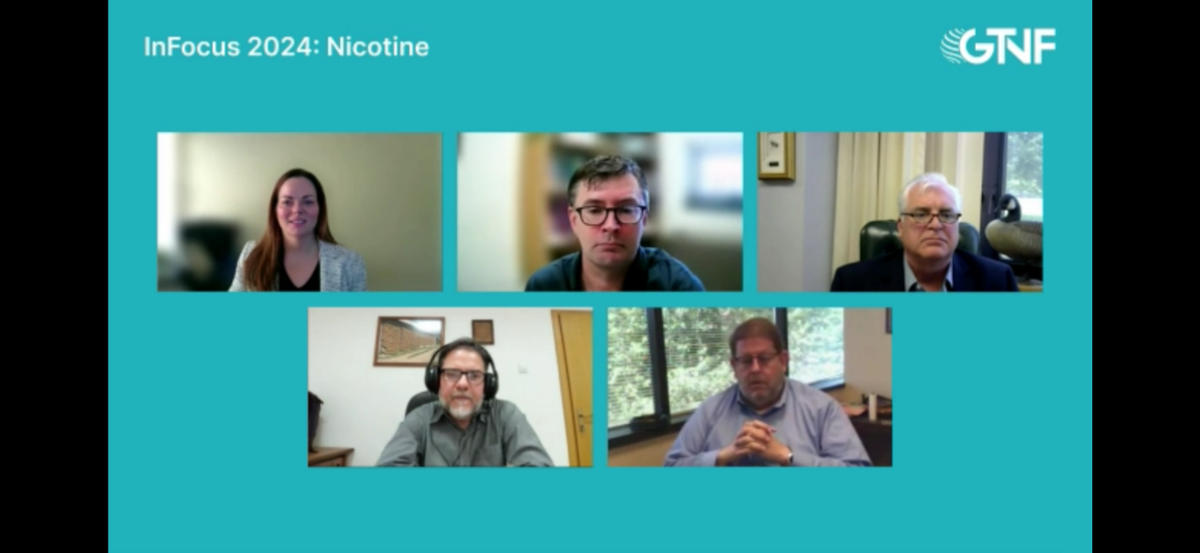
The second seminar focused on the upstream tobacco agriculture of the nicotine industry and the welfare of related farmers|Source: GTNF
In the seminar, the guests analyzed the development of upstream tobacco agriculture from various links of the supply chain, including tobacco farmers, tobacco buyers and regulators; proposed that tobacco quality is crucial to the interests of all parties; and Professor Lewis of Plant Science specifically proposed that the cultivation of new varieties of high-quality, high-yield and disease-free tobacco through genetic modification and other means has been proven successful in the past decade; in the future, increasing the added value of raw tobacco products through similar research and development will also be an important focus of the industry.

The second seminar focused on the upstream tobacco agriculture of the nicotine industry and the welfare of related farmers|Source: GTNF
The guests at the meeting agreed that not everyone realizes that nicotine is similar to bulk agriculture such as animal husbandry and planting, and also has a "farm to table" process. The interests of farmers who make a living by growing tobacco leaves also need to be guaranteed in this process. Only in this way can we meet the increasingly high ESG requirements of regulators and society for nicotine companies.