2025 Forecast Report on the Future Trends of the Electronic Cigarette Industry
Leave a message
1 Market Trends and Growth Potential
(1) In the next two years, the growth area of the global e-cigarette market will mainly be in North America. 52.0% of the respondents believe that North America will be the main growth region, accounting for the highest proportion, far exceeding other regions. Emerging markets also rank second in terms of proportion.

2. Technological Innovation and Product Upgrade
(1) AI-driven Personalized Experience and Eco-friendly Design are most likely to be Popular. The selection rate for AI-driven personalized experience is 68%, and that for eco-friendly design is 55%, which is much higher than other options.

(2) The popularization of different technological innovations is correlated with the growth regions of the global e-cigarette market to some extent.
(3) Brand marketing and channel construction are the most valued aspects. AI personalized experience is a common concern in the questionnaire. The number of respondents choosing brand marketing and channel construction is the largest. Moreover, most users believe that AI-driven personalized experience may become widespread in the future, reflecting its importance. Different investment directions have different emphases on the selection of technological innovations, presenting certain differences.
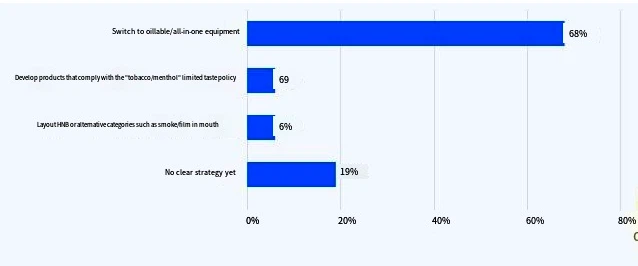
3. Policy and Regulatory Responses (1) Most enterprises respond to the trend of bans by choosing to shift to oil-injectable/multi-injector devices. Among the completed questionnaires, 68% of enterprises chose this strategy, accounting for the highest proportion. Other options were relatively low.
(2) Taste restrictions and age verification are the biggest policy risks that Chinese e-cigarettes face when exporting.

(3) In the face of various policy risks, enterprises tend to turn to injection molding/multi-in-one equipment to cope with them.
4. Supply Chain and Industry Challenges (1) Severe internal competition is currently the core bottleneck of the e-cigarette supply chain. In the case of multiple choices, 69.79% of practitioners agree that the internal competition is severe, accounting for the highest proportion of 74.0%, far exceeding other options.

(2) There is a certain correlation between supply chain bottlenecks and enterprise response strategies, and "switching to oil-injected/multi-injection equipment" is more favored.
(3) The investment direction of enterprises is related to supply chain bottlenecks to some extent. The problem of internal competition is prominent.
The industry should unite and cooperate to set unified standards and jointly go global.
5. Consumer Demand and Competitive Landscape (1) In the valid questionnaires, 61.0% of the respondents prefer natural plant extract flavors for innovation, such as mint and fruits, which is much higher than other options, indicating that consumers prefer natural plant extract flavors.

(2) Consumers' sensitivity to the price of e-cigarettes and their demands for health safety have significantly increased.

(3) Speed of Technological Innovation and Regional Market Localization Operations are Key Data show that 32% of the respondents believe that speed of technological innovation and regional market localization operations are the key elements for the competition of leading brands in 2025. These two items rank equally highest, indicating their significance in the e-cigarette industry.

(4) The acceptance of different flavor innovations by consumers is greatly influenced by regulations. Most users believe that flavor innovations such as those based on natural plant extracts are restricted by regulations and are only feasible in a limited market. For instance, 84% of users who choose natural plant extract flavors hold this view, which is the highest among all.
(5) The demand for natural plant extract flavors among consumers is relatively high among various demand changes, and the interest in products with social attributes has increased. Among different categories of demand changes, the proportion of users choosing natural plant extract flavors exceeds half in most cases. Among those who prefer portable/hidden devices, 60% choose it. Among those who have an increased interest in social attribute products, 67% choose it. Among those who have a higher price sensitivity, 55% choose it. Among those who have higher requirements for health and safety, 47% choose it.
(6) Health safety and price sensitivity are the key concerns in the future e-cigarette industry among the key factor options. Among them, the proportion of choosing higher requirements for health safety and higher price sensitivity is relatively high, reflecting that these two points are the core focus areas.
6. Substitutes and Industry Disruption (1) The market prospect of industrial hemp e-cigarettes is limited, and regulations are the main factor. 64% of respondents believe that industrial hemp e-cigarettes are restricted by regulations and can only be feasible in a limited market, indicating that regulations are the main factor restricting its development.

(2) The majority of people believe that HNB products and the e-cigarette market will complement each other. 52% of the respondents believe that HNB products will complement the e-cigarette market, accounting for the highest proportion. Only 13% think that HNB products will squeeze the e-cigarette market.

(3) Different views on industrial hemp e-cigarettes lead to different choices of growth regions for the global e-cigarette market. Users who believe that industrial hemp e-cigarettes will become mainstream tend to favor North America; users who think that regulations restrict them choose many regions including Africa and Southeast Asia; users who consider the technical threshold high tend to focus on North America. Different views result in different regional choices.
(4) Compliance ability and technological innovation have a significant impact on the e-cigarette market. The data shows that a large number of users choose "compliance ability" and "technological innovation speed". Among the users affected by the choice of HNB products, the viewpoints of "complementary formation" and "partial substitution" are relatively evenly distributed, but in terms of technological innovation speed, users are more inclined to believe that HNB products will form complementarity and partial substitution. This indicates that users consider compliance ability and technological innovation speed as key elements for the competition among leading brands, and HNB products may have a positive impact on the vaping e-cigarette market, meeting the needs of traditional smokers and partially replacing the existing market.
7. Investment, Financing and Industry Confidence (1) In the next two years, enterprises tend to focus on brand marketing and channel construction as their key investment directions. In the statistics of valid questionnaires, 48.0% of enterprises choose brand marketing and channel construction, accounting for the highest proportion.

For the content posted by users who chose the "5 - Others" option, we have extracted the following two core viewpoints:
Health-based vaping direction (50%): The enterprises' key investment focus in the next two years will revolve around health-based vaping, emphasizing the research and development of the health attributes of products.
No investment direction (50%): The enterprises in the local market of the electronic cigarette industry have no key investment direction in the next two years.
(2) Compliance technology and emerging market local brands receive the most attention from capital. Compliance technology and emerging market local brands each account for 32% of the selection rate, being the highest two items, indicating that capital has a relatively high interest in these two fields.

(3) There is a certain correlation between the capital focus areas and the export policy risks of electronic cigarettes. Compliance technology users mostly consider the compliance requirements of age verification technology as the main risk; users concerned about emerging market local brands believe that the risk of tax increase is relatively large; among users focusing on medical-grade nebulization equipment, the restriction on flavors is regarded as a high-risk factor. Users from different capital focus areas have certain preferences in their views on export policy risks, reflecting a certain correlation.
Conclusion
Summary: The questionnaire survey indicates that the e-cigarette industry will exhibit a diversified development trend by 2025. The North American market has great growth potential, and AI-driven personalized experiences and environmentally friendly designs may become widespread. Technological innovation is related to regional markets, and brand marketing and channel construction are valued. Companies should shift to oilable/multi-in-one devices to cope with bans, while policy risks such as restrictions on flavors and age verification are policy risks for China's exports. Internal competition is a supply chain bottleneck. Consumers prefer natural plant flavors, and their price sensitivity and health safety requirements are increasing.
Recommendations: Enterprises should increase efforts to expand in the North American market, pay attention to the application of AI technology and environmentally friendly designs. Strengthen brand marketing and channel construction to enhance competitiveness. In response to policy risks, plan product transformation in advance, such as oilable/multi-in-one devices. Optimize the supply chain to alleviate the internal competition problem. Pay attention to changes in consumer demands and develop products with natural plant flavors that meet health and safety standards. At the same time, focus on the development of compliance technologies to meet the policy requirements of different regions.