With The Expectation Of A Sharp Increase in Tariffs, Where Is The E-cigarette Trade Between China And The United States Heading?
Leave a message
With the expectation of a sharp increase in tariffs, where is the e-cigarette trade between China and the United States heading?

As Trump is about to enter the White House for the second time, the US's increase in tariffs on Chinese goods has become a common expectation. As the world's largest e-cigarette supply chain and largest market, what will be the future direction of e-cigarette trade between China and the United States? Which will be the greater risk: tax increase, compliance, or industry relocation? In-depth report from 2Firsts.
Disclaimer:
[1] This article only discusses e-cigarette regulation and business issues, and all content is only for readers in the global new tobacco industry.
[2] This article does not involve analysis and commentary on any political or diplomatic issues. All content in this article shall not be cited for political or diplomatic purposes.
[3] The remarks and opinions of the relevant persons involved in this article are only for objective information transmission and do not represent the views of 2Firsts. In this article, 2Firsts does not comment on the views of the relevant persons in other fields.
[4] The statements on current affairs and diplomacy are subject to official statements.
On November 25, the newly elected US President Donald Trump published two posts on the social platform "Truth social" he founded, announcing that he would significantly increase tariffs on goods from Mexico, Canada and China from the first day of his administration. Among them, a 25% tariff is imposed on all products entering the United States from Canada and Mexico. For goods from China, an additional 10% tariff is added on top of the 25% tariff that was already added during his previous term. Previously, during the campaign, Trump said that he had proposed to impose tariffs of up to 60% on all Chinese goods.
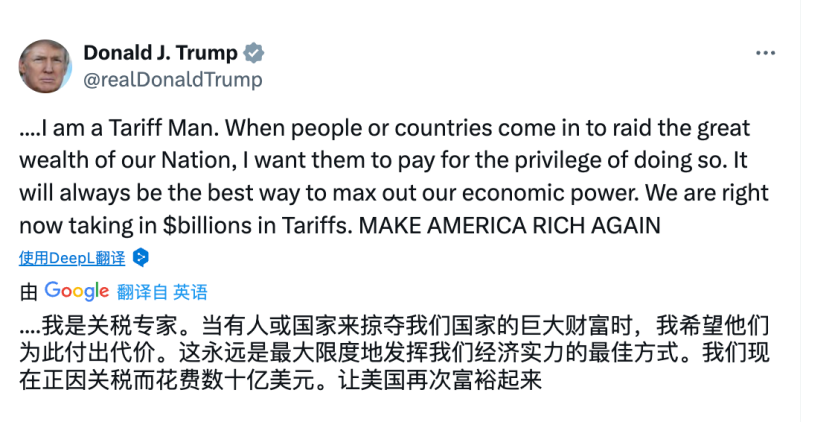
On December 4, 2018, Trump called himself a "tariff expert" | Source: Trump's official X account
Looking back on the 2017-2021 term, the Trump administration frequently used tariffs and other means to adjust the US trade structure. Among them, the most extensive 301 tariffs imposed 7.5% to 25% tariffs on Chinese goods worth more than US$300 billion, including e-cigarette equipment and parts.
In the field of e-cigarettes, China is the largest supply chain center, producing more than 90% of the world's e-cigarettes. The United States is the world's largest market. Sino-US e-cigarette trade occupies a pivotal position in the world. Trump's statement on China's substantial increase in tariffs, once implemented after he takes office, what impact will it have on Sino-US e-cigarette trade? In addition to trade, how will compliance, industry outflow and other issues affect the direction of Sino-US trade. 2Firsts communicated with many industry practitioners.
The game between tariff increase and gray tariff
In 2018, China and the United States negotiated on tariffs. It was not until January 2020 that the two sides reached the first phase of the China-US trade agreement. The United States agreed to reduce the new tariffs on $120 billion worth of Chinese goods by half to 7.5% within 30 days. However, the 25% tariff imposed by the United States on goods worth $250 billion earlier remained unchanged, and e-cigarette equipment and parts were among the $250 billion.
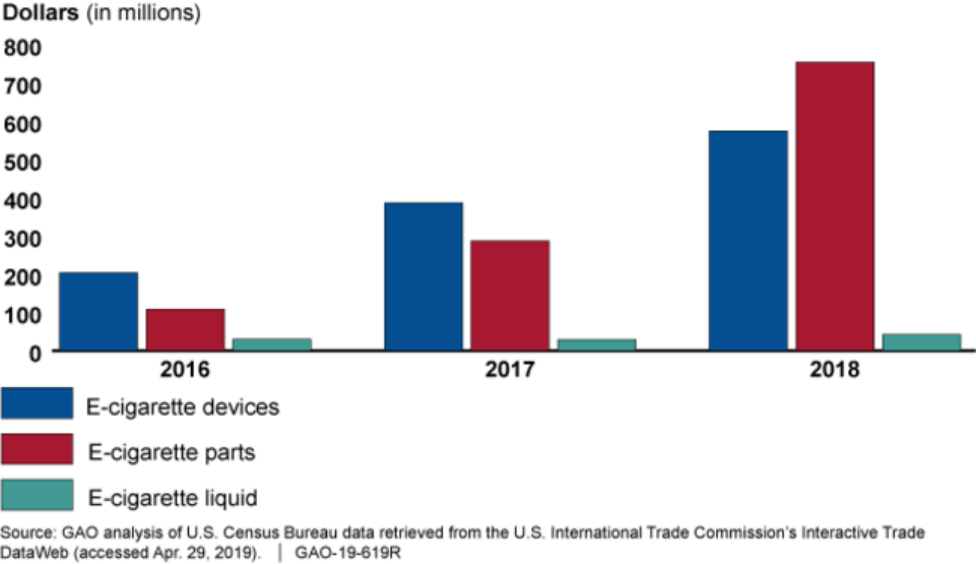
The customs value of electronic cigarette equipment, parts and e-liquids imported into the United States from 2016 to 2018 | Source: U.S. Government Accountability Office
Mr. A, who has been engaged in electronic cigarette logistics for many years, revealed to 2Firsts that the normal declared tariff for electronic cigarette products from China entering the United States is "27.86%". Among them, "the original tariff was 2.86%, and the additional tariff was 25%."
He admitted that "the last time the Trump administration increased it by 25%, it did not have a big impact on us overall."
Mr. A said that after the last tariff increase, many companies in the industry chose to ship to the United States through "gray customs". If the normal U.S. electronic cigarette tariff standard is followed, the logistics and other costs of the product will be fed back to the market terminal.
In Trump's "10%" statement this time, 10% is an additional tariff, which means that e-cigarette products will be subject to a tariff of 37.86% (the original tariff is 2.86%, the last tariff is 25%, and the additional tariff is 10%).
Mr. A said, "But if he really implements the 60% tariff policy on all Chinese goods, it will only aggravate inflation in the United States."
China Daily cited research that since 2018, the United States has imposed substantial tariffs on some Chinese goods, and American import agents, wholesalers and retailers have borne more than 90% of the cost of the additional tariffs. They have passed the pressure on to downstream producers and end consumers in the form of "price increases."
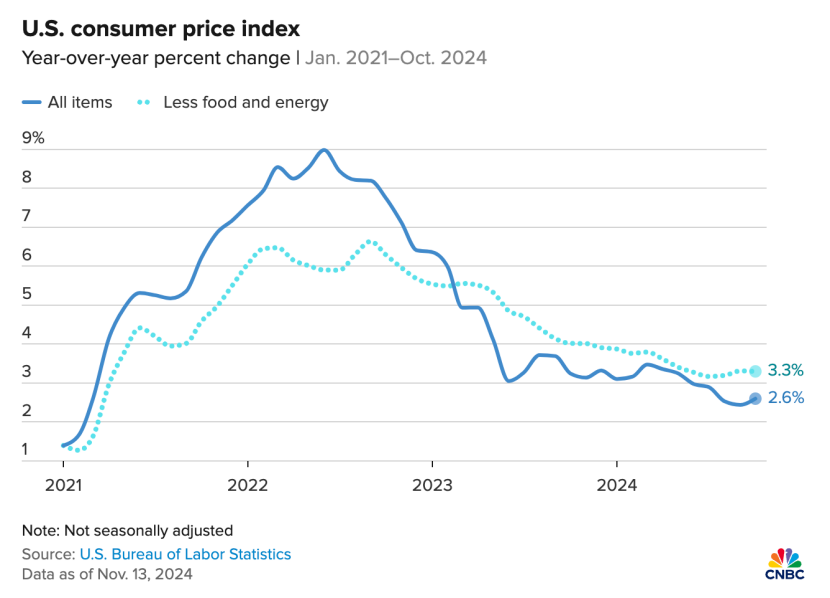
U.S. Consumer Price Index | Source: U.S. Bureau of Labor Statistics
"The wool always comes from the sheep. Raising tariffs will increase the tariff costs, and the sales price in the United States will naturally rise." Mr. A said.
Manufacturing overseas to avoid tariff sanctions
Mr. A believes that if the United States continues to increase and implement tariffs significantly in the future, it will have a greater impact on the leading e-cigarette companies, and they "may move their positions to Southeast Asia." He also observed that many companies in Shenzhen have moved to Indonesia, Vietnam, Malaysia and other places for production.
According to known public information, many e-cigarette production companies have chosen to build factories in Indonesia, including well-known companies such as Smoore, Meishenwei, Honeycomb Factory, Kikna, and Jinjia.
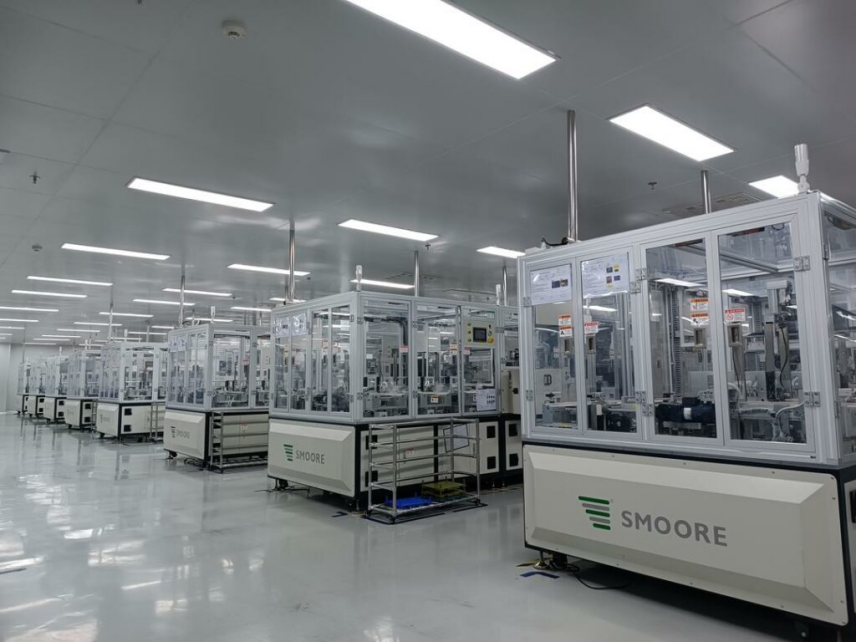
Smoore's Indonesian factory | Source: Smoore Indonesia
According to data released by the United States International Trade Commission (USITC) in June 2023, in the first half of 2023, the United States imported only 63.7% of e-cigarettes from China, while e-cigarettes from Indonesia accounted for more than 35% of its share. Indonesia has become the second largest source of e-cigarette imports in the United States. Especially in 2020, Indonesia restored the most-favored-nation trade treatment. Indonesia only needs to pay an import tariff of 2.6% for e-cigarette kits exported to the United States. The preferential tax rate further enhances its competitiveness in the US market.
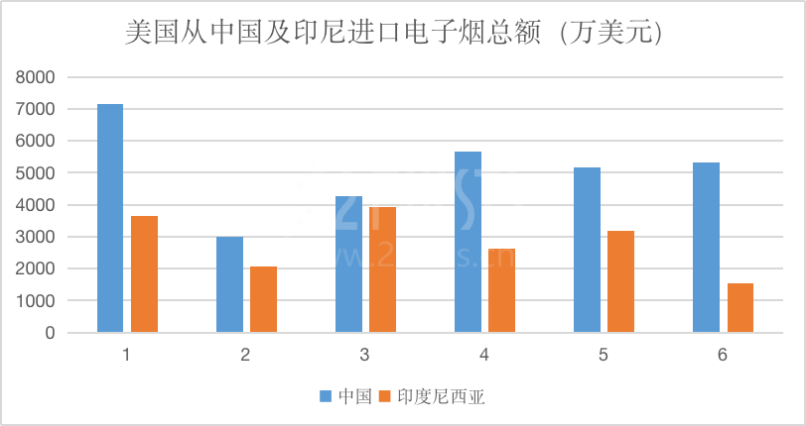
Changes in the total amount of e-cigarettes imported by the United States from China and Indonesia | Charting: Two Supremacy
But there are still hidden dangers in manufacturing overseas. As the United States intensifies its trade sanctions against China, some countries have expressed their unwillingness to become "vests" of Made in China. In December 2024, Malaysia's Deputy Minister of Investment, Trade and Industry, Liu Zhendong, said that Malaysia has urged Chinese companies not to use the country as a transit point for relabeling products to circumvent US tariffs. Many Chinese companies are advised not to invest in Malaysia if they just want to relabel their products through Malaysia to circumvent US tariffs.
Logistics industry: Air transport to sea transport, multiple ways to reduce the impact of high tariffs
Mr. B, who has been deeply involved in the logistics industry for many years, told 2Firsts that according to previous measures taken by Trump after he took office, tariff increases are inevitable, which will directly lead to an increase in the cost of US e-cigarette logistics. Most e-cigarette companies will still use the "gray clear" method to enter the United States. The increase in tariffs will increase the volume of gray clears, which also means that the inspection rate will increase.
He recently noticed that the United States has also tightened imports of small commodities. "Even now, the Hong Kong flight bill of lading shows that the goods of cross-border e-commerce will be blocked and the difficulty of customs clearance will increase."
Talking about the common response methods in the logistics industry, he said, "We use multimodal transport to provide customers with a variety of transportation solutions to reduce transportation costs. For example, using the Mason Express to transport e-cigarettes, the time limit is 12 days to Hong Kong and 15 days to overseas warehouses after sailing, and the transportation cost is one-third of air transportation."
Can e-cigarettes be transported to the United States by transiting through other countries or regions to reduce tariffs? He believes that "gray-cleared" e-cigarettes are basically flown from South Korea, and at present, tariffs cannot be reduced.
"The U.S. Customs knows that 90% of e-cigarettes come from China, and the transit in different regions is basically the same. As for whether the transportation route is adjusted, it actually depends on the customs clearance industry resources of each logistics company." He said.
E-cigarettes "Made in the United States" are difficult to achieve in the short term
"Make American Great Again" is Trump's core political slogan. And one of its main policy strategies is "manufacturing reflux", that is, attracting the return and concentration of manufacturing to the United States.
In terms of the core tax rate policy, Trump said he would further reduce the corporate tax rate for companies that manufacture products in the United States to 15%. In 2017, Trump had already reduced the tax rate from 35% to 21%.
President Trump's campaign slogan for 2024 is still "Make American Great Again" | Source: Trump's official X account
In response, Mr. B told 2Firsts that production will definitely not be transferred to the United States. "China's e-cigarette industry ecosystem is very concentrated and the industry is well-equipped, so the R&D and production costs of e-cigarettes are the lowest in the world. Industrial transfer is very difficult, and the frequent changes in US policies have led to Chinese companies not having the confidence to localize production in the United States."
Mr. B is more optimistic about building a factory in Southeast Asia. He believes that Southeast Asia can produce cheap e-cigarettes, but "no matter from the appearance, style, function, taste and packaging, only those produced in China have texture."
"In short: our core advantage is the overall cost leadership." Mr. B said.
Small businesses: You can avoid tariffs, but you can't avoid the account period
Mr. C, who has been engaged in e-cigarette channels in North America and Latin America for a long time, told 2Firsts that the United States does not seem to increase tariffs on small commodities, especially consumer goods such as e-cigarettes, in the short term, but the supervision of e-cigarettes may be more stringent, especially for companies with high compliance requirements.
Mr. C considers himself a "small player" and the change in tariffs will not affect his own situation.
"It may have an impact on a few leaders who are particularly particular about compliance, but it has no impact on us small players."
He explained, "Our channels only make 50 cents or 1 yuan. As long as you are cheaper than cigarettes, people will use it, and there will be room for us channel dealers." In contrast, he is more concerned about the disorderly competition in the US market.
"Involution" is getting more and more serious, and the payment period of one month or even longer has made it difficult for many small and medium-sized enterprises to survive. For example, on July 30 this year, Shenzhen Wuke Technology Co., Ltd. issued a "Notice on the Suspension of Production and Closure of the Company". The notice shows that "due to the impact of the international market on downstream customers, the goods are unsalable, and a large amount of payment has not been recovered, resulting in a serious shortage of funds for the company... The brand side and the US agent directly lied down and refused to pay, which directly led to the company's cash flow being broken", and finally announced the suspension of production and closure, and will enter bankruptcy procedures.
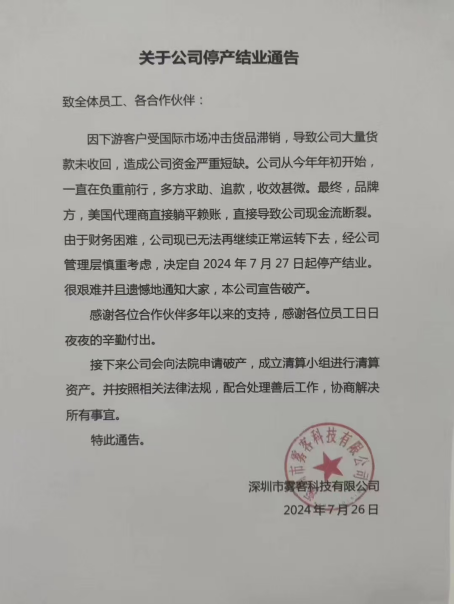
Content of the "Notice on the Company's Suspension of Production and Closure" issued by Shenzhen Wuke Technology Co., Ltd. | Source: Wuke Technology
Although some companies have recently chosen to reduce their resource investment in the United States or even withdraw, thereby cooling down market competition, the issue of credit period still exists. For small and medium-sized enterprises with already tight cash flow, the "credit period model" is tantamount to adding insult to injury.
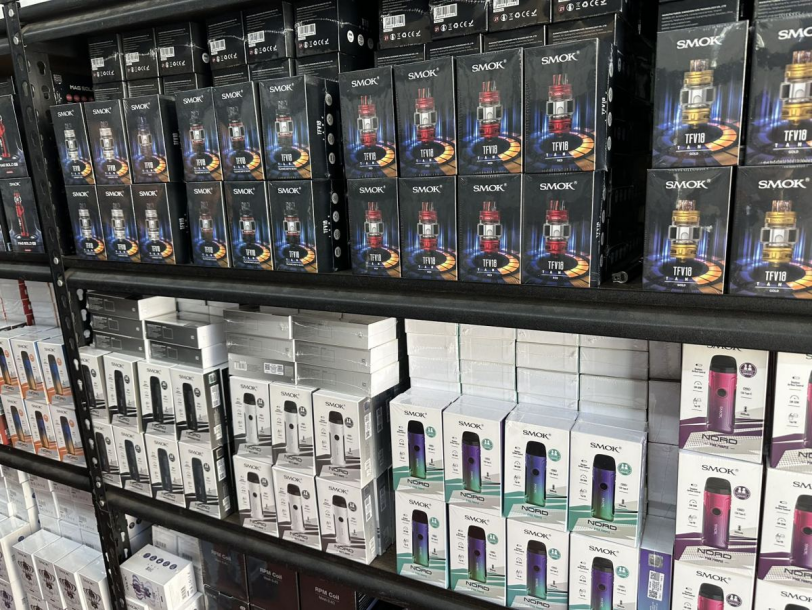
2Firsts photographed an e-cigarette store in Los Angeles | Source: 2Firsts
A practitioner in the US e-cigarette market once told 2Firsts that the current common payment period in the industry is 1-3 months, and "the better the relationship with the customer, the longer the payment period may be." But he admitted that now he generally trades with familiar customers, and "only accepts some cash orders" for e-cigarettes.
Mr. C also suggested that small businesses concentrate resources and reduce costs under the existing conditions to concentrate resources to impact the Latin American or Middle Eastern markets.
"If you want to enter the US market, either you have established a strong distribution body there, or have a deep cooperation with your distribution company, or you spend money and technology. How can we small players enter? For small players like us, there is no chance at all."
The US market faces the next round of reshuffle
The latest export trade data shows that China's e-cigarette exports in October totaled about US$890 million. The United States is still the largest export destination, with exports reaching US$280 million, accounting for 31% of the export share.
Since entering 2024, the regulatory environment of the US e-cigarette market has also been changing. In June 2024, the FDA authorized four menthol-flavored e-cigarette products from Altria's NJOY for sale in the United States for the first time. This is the first time the FDA has approved non-tobacco flavored e-cigarettes.
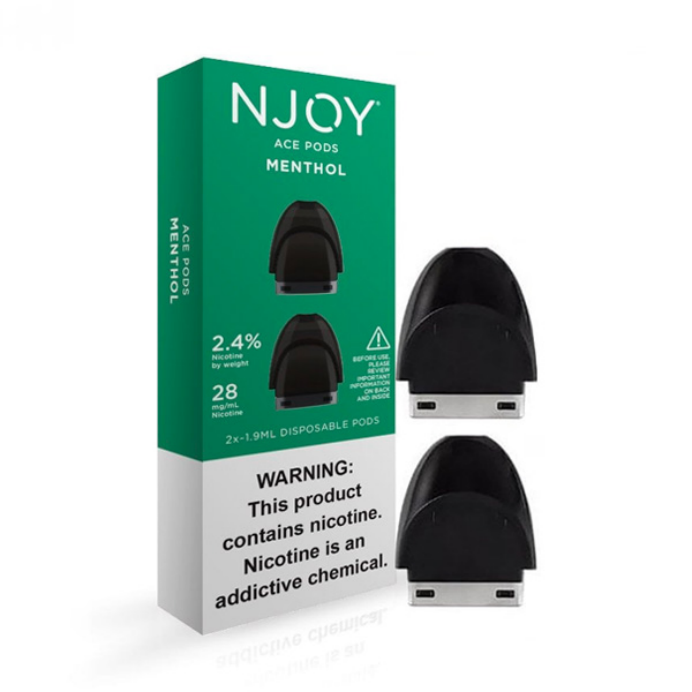
NJOY ACE Pod Menthol 2.4% obtained a marketing authorization order (MGO) | Source: NJOY
In the same month, the FDA announced that it would cooperate with the Department of Justice (DOJ) to form a multi-department joint law enforcement team to crack down on unauthorized fruit-flavored disposable e-cigarettes imported from China.
In October, the FDA and the Customs and Border Protection (CBP) jointly seized a batch of e-cigarette products worth $76 million. In addition, the FDA has issued multiple warning letters on smartphone-style e-cigarettes sold on the market.
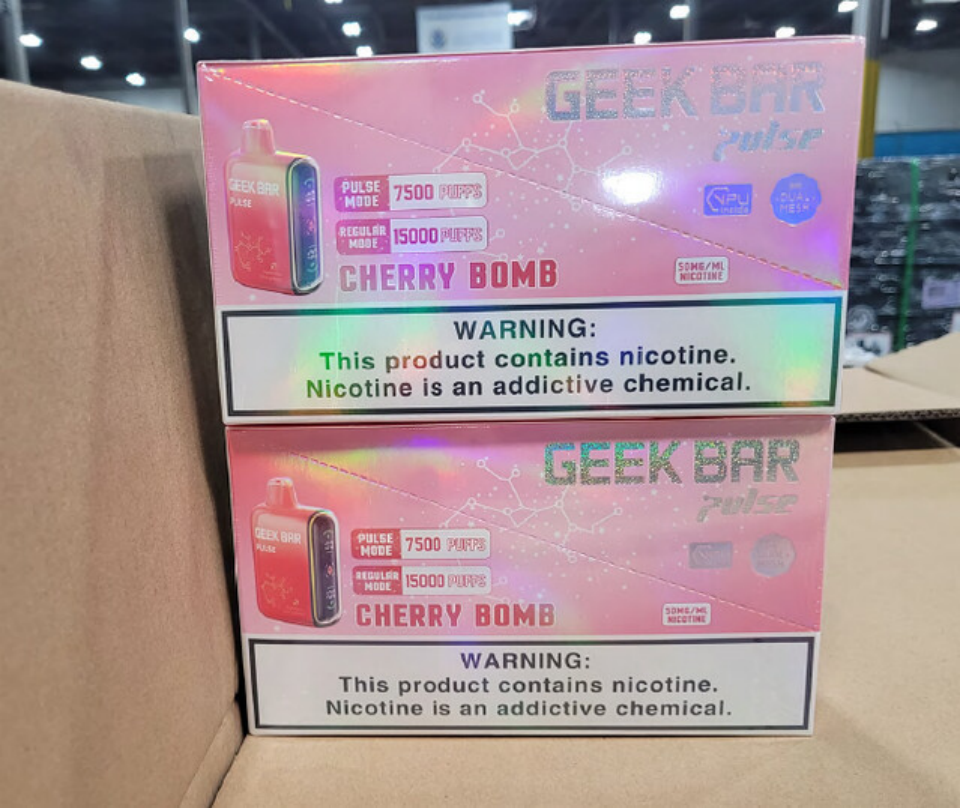
FDA seized illegal e-cigarettes including GEEKBAR | Source: FDA official website
Beyond regulation, the new tobacco market in the United States still attracts the attention and investment of the industry.
Philip Morris International (PMI), British American Tobacco (BAT) and Altria have been promoting the pace of transformation to new tobacco products in recent years. Philip Morris International's Q2 financial report shows that the shipment volume of nicotine bags ZYN in the United States reached 135.1 million cans, a year-on-year increase of 50.3%. In addition, Philip Morris International is also promoting its heated tobacco product IQOS to re-enter the United States. It is expected to launch an IQOS pilot program in Austin, Texas.
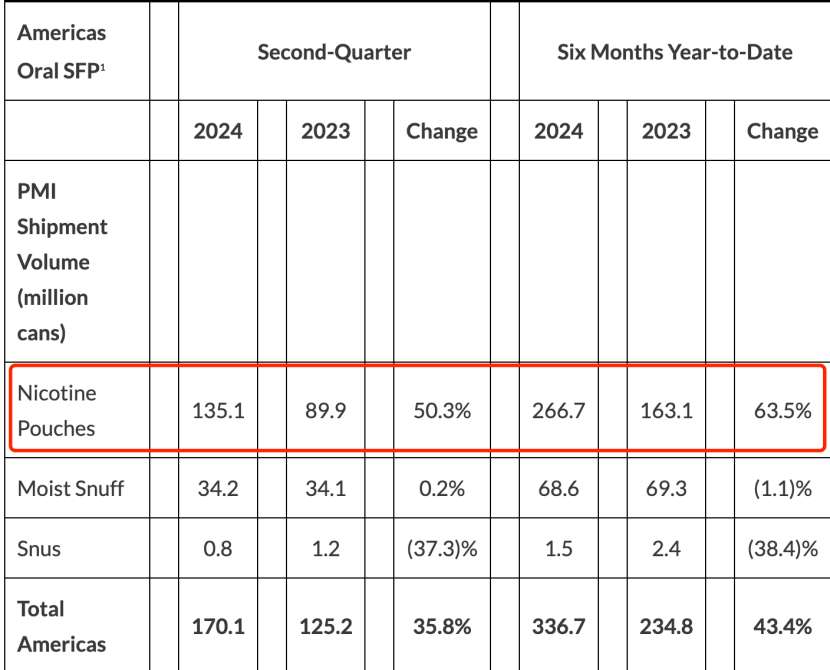
Philip Morris International's Q2 financial report shows a significant increase in nicotine bag shipments | Source: PMI
Faced with the coexistence of US market regulation and opportunities, a small number of leading companies have accelerated their preparations for response, such as stepping up PMTA applications and accelerating the progress of overseas factory construction. But more companies are still waiting and watching. As Mr. A said, "Everyone is waiting and watching. Once the head is knocked down, there will be a chance to take the lead."
SKY, an investor who has been paying attention to the e-cigarette industry for a long time, expressed a similar view that the new round of tariffs will cause the industry to start reshuffling.
"The most feared thing is that because of the increase in tariffs, the increase in the US Customs Enforcement Budget will lead to crazy seizures. Chinese companies are afraid of seizures but not tax increases. Considering the current gray customs, the reshuffle of the industry is almost inevitable." SKY said.
For Chinese e-cigarette companies with low-cost competition as their core advantage, the pressure of tariff costs and violation costs is particularly prominent. The real opponent of this group is the large international tobacco companies with stronger financial strength and scale effects, which can deal with cost increases more calmly.
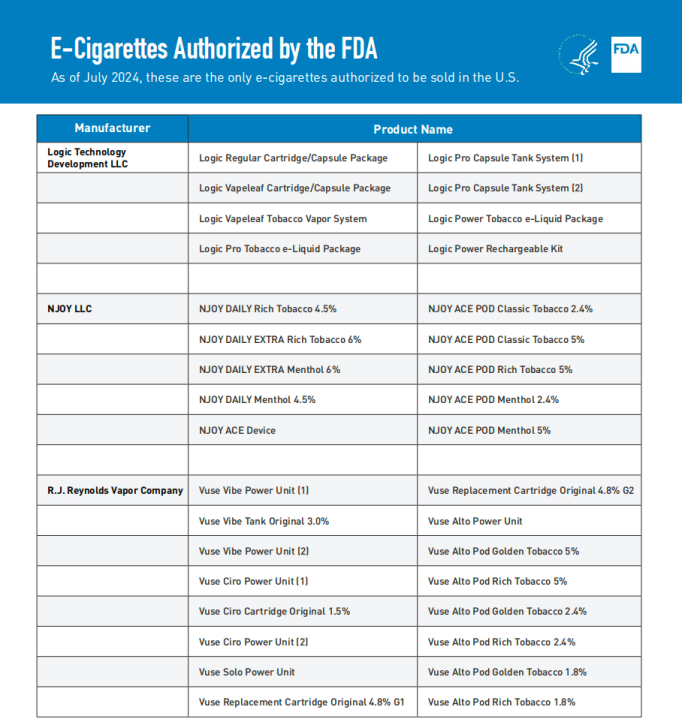
Currently, 34 products that have obtained marketing orders all have backgrounds in international tobacco companies | Source: FDA
A practitioner who has withdrawn from the US market expressed his opinion: "We all know that tariffs are foreseeable risks, but they also mean redistribution. The key is who can survive this storm and stand to the end."
In the ocean, when a whale reaches the end of its life, its body slowly sinks into the quiet and dark deep sea area. There is no sunlight here, and the living environment is very harsh. For deep-sea creatures, the death of whales has become a rare opportunity for survival. With the sinking of whales, a unique ecosystem gradually formed on the seabed, making the desolate land revitalized.
"There are deep-rooted teams of Chinese small and medium-sized brands waiting to rise in the United States. They are all waiting for 'one whale falls, all things come to life'." Mr. A said.
Picture: Generated by ChatGpt