Lawyer's Interpretation: Renault's Patent No. 202 And 337 Cases, Chinese Companies May Face The Risk Of Being Defeated One By One
Leave a message
Lawyer's interpretation: Renault's patent No. 202 and 337 cases, Chinese companies may face the risk of being defeated one by one

Tang Shunliang, partner of Tianyuan Law Firm, said that Reynolds applied to the U.S. International Trade Commission (ITC) to prohibit 42 companies, including Chinese e-cigarette companies, from selling e-cigarette products that infringe its No. 202 patent in the United States. However, Chinese e-cigarette companies, as always, lack the trend of united response. If these companies continue to wait and see without taking the initiative, they will face the risk of being defeated one by one by Reynolds.
Special statement:
1. This article is an expert opinion contribution. The opinions stated in the article only represent the personal position of the expert, not the position of the two supremes.
2. The two supremes forward this article to convey information, not to recognize or support its content.
3. The two supremes have obtained the author's authorization to publish. Readers should pay attention to its accuracy, completeness, and reliability when reading, and treat the opinions and suggestions therein with caution.
On June 11, 2024, Reynolds American (Reynolds American) applied to the U.S. International Trade Commission (ITC) to prohibit 42 companies, including Chinese e-cigarettes, from selling e-cigarettes that infringe the No. 202 patent in the United States.
The defense time at the end of July is approaching. As in the past, Chinese e-cigarette companies have not shown a strong trend of unity and confrontation. If they continue to wait and see and do not take the initiative, they will face the risk of being defeated by Renault one by one.
China's e-cigarette industry has not formed an industry alliance response mechanism in the past 20 years
Through recent exchanges with the defendants and analysis of similar cases in the past, it can be seen why Chinese e-cigarette companies have been sued repeatedly in the United States, but can hardly produce a public winning judgment. There are several reasons:
Joint response is difficult. When facing US patent litigation, the market share, brand ownership, and compliance level of each company are different; the boss's level of cognition is different; plus the professionalism of the legal and IPR departments responsible for the selection of law firms, the understanding of the case itself, and how to choose a law firm and the cognition of the response strategy are also uneven, resulting in the defendants wanting to unite, but unable to unite, and even some companies still have the idea of free riding.
Give up the defense strategy. As competition in the US market intensifies, compliance enforcement is becoming more and more stringent. In the face of high attorney fees, some Chinese e-cigarette OEM companies with a small market share in the US have already made preparations to give up resistance.
Delaying coping strategy. Taking the US11925202B2 patent as an example, it was applied for on March 31, 2023 and authorized on March 12, 2024. The earliest priority cited was US 7,726,320, which was applied for on October 18, 2006 and expired on October 18, 2026. In view of this, some companies intend to use delaying tactics to deal with it at the lowest cost. However, if Renault simultaneously initiates a patent infringement compensation lawsuit in the state court, it will also bring huge compensation.
Mutual competition. Some e-cigarette companies believe that Renault's main target is a few large companies, not companies with weak brands. If large brands are banned, small brands can still have some room for growth, including entering the US market through non-compliant means, which will also bring sales growth. However, judging from the previous round of 337 investigations on illegal trade by Renault and the second round of attacks on Patent No. 202, no company can be immune to this 337 investigation.
No mature team of lawyers. Patent litigation response has a distinct feature: the inheritance of technical background. For decades, multinational tobacco companies have had at least several patent firms (law firms) in long-term employment relationships. Their lawyers are familiar with patent technology and do not need the assistance of company lawyers or IPRs. This will save their lawyers a lot of learning technology costs and communication costs with company IPRs.
Obviously, before encountering litigation, Chinese e-cigarette companies have limited reserves and investments in overseas law firms for their own services, including patent infringement analysis (FTO) of target markets, which is mainly the responsibility of domestic teams.
Therefore, once a strong American law firm is temporarily selected to respond to the lawsuit, if they lack technical experience in the e-cigarette industry, the quotation is generally higher, because they need to spend a lot of time on intensive learning before they can confront Renault's lawyers.
In addition, corporate legal affairs that lack experience in patent litigation are also very inadequate in the selection of response strategies, the briefing of overseas lawyers, and the control of costs.
If the counterattack is not strong enough, the ITC may issue an injunction in about 6 months
In Renault's complaint, it first stood on the moral high ground and labeled the e-cigarettes from China as "illegal", so any measures taken to stop this "illegality" are "just". Renault also mentioned that the ITC's ban on the accused e-cigarettes from China will not affect the "public interest", and e-cigarette consumers will not choose to smoke cigarettes, and the output of VUSE is sufficient to meet the choice of consumers.
What is more difficult is that the judges will be affected by previous cases related to e-cigarette patents, which is a great test for the defense of the defendant's lawyers, because Renault has used the same family patents of Patent No. 202 to win the IQOS entry ban in the United States, resulting in IQOS delaying entry into the US market for at least 3 years.
The two tobacco companies have been engaged in patent litigation for more than five years. Although BAT and PMI have reached a global settlement, BAT's heated tobacco products represented by Glo have no competitive advantage over IQOS. IQOS is occupying the market with rapid growth. In this case, BAT has set its sights on the vapor market, and it may be normal to list Chinese electronic companies as the number one enemy.
Therefore, Renault's ambition for vapor is concentrated on the 337 investigation of the "Patent No. 202". It is expected that before it expires in 2026, it will be difficult for Chinese e-cigarette companies to compromise and reconcile, unless the defendant company puts forward a very strong defense to hinder the ban or cause Renault to withdraw the lawsuit.
Try to change the judge's view on Renault's Patent No. 202
From previous patent litigation cases in the United States and Europe on electronic cigarettes (HNB), lawyers' understanding of the industry, standing at a certain height, turning from passive to active, and building a set of argumentation systems that can convince judges, avoiding falling into specific technical details, is very effective in influencing the judge's final ruling.
Taking this case as an example, the technical solution required for protection by Patent No. 202 has not been authorized in other countries and regions. It is a "trap" designed entirely for the US one-time large-volume vapor. It is intentional and naturally has flaws.
1. Find "contradictions" from previous cases
Just as BAT successfully invalidated a major patent of PMI in a previous case, its lawyers attacked PMI's divisional application (or continuation application) at the beginning:
It is apparent that in formulating its various Patents and their claims sets, Philip Morris has not been guided by what it considers its true invention (if any) to be. Instead, Philip Morris' motivation is to maximise its chances of a finding of infringement by mining its Grandparent Application for individual features, which it then crafts together in a myriad of different ways to create a claim set that (so far as possible) maps onto the resistiveheating glo device.
In approaching its patent portfolio in the way that it does, Philip Morris is taking advantage of the system of "divisionals". The divisionals system was put in place as a way to permit a patentee who has included more than one invention in its original application the opportunity to correct that and avoid the objection of multiplicity of inventions that would otherwise be raised by the patent office.
The system of divisionals allows a patentee who has filed a patent application to file further patent applications based on the original application and to claim the priority date of the original application. Provided that the original application is still pending (e.g., it has not proceeded to grant or been withdrawn), there is no limit to the number of divisional applications that the patentee can file.
Interestingly, Altria, which was listed as a defendant together with PMI, fought back in a case against Reynolds' VUSE for infringement:
Plaintiffs' attempted enforcement of the Asserted Patents against ACS and PM USA is barred by one or more of the equitable doctrines, such as estoppel, acquiescence, waiver, and unclean hands.
Apparently concerned by the commercial threat posed by IQOS, RJR is now attempting to stop IQOS with this case. But in its haste to stop IQOS, RJR committed two fatal errors. First, it asserted meritless patent claims. Second, it overlooked the fact that its own e-vapor products infringe multiple patents owned by ACS, PM USA and co-defendant PMP.
Denied. Plaintiffs filed for the '542 patent in September 2019 and attempted to draft claims directed at the Accused Products, but the claims are far removed from the alleged invention possessed at the time of filing and described by the inventors when they filed the original patent application on August 9, 2011 and are therefore invalid for, among other things, lack of written description, anticipation, and obviousness.
In the PMI "556 patent" case, Renault challenged the invalidity of the patent and believed that: Based on the teachings of the comparative documents, for a "person with ordinary skills in this field", using materials with different pore sizes to "adapt to the optimal performance of aerosol flow in the device" (the focus of the dispute is essentially the flow of e-liquid) is a conventional technical means and obvious, and the judge adopted this opinion.
The space is limited and the specific details of the case cannot be expanded. The 202 patent also includes the estoppel, unclean hands, lack of written description, and obviousness mentioned in the above case. description, obviousness, etc.
2. There is no chance for non-infringement defense, but it does not mean giving up directly
In patent litigation and invalidation declaration, lawyers thoroughly understand the technical features of the product and the patent involved, and fully put forward the non-infringement defense of "different features", which will undoubtedly force the patent owner to explain the claims, and can only explain them in combination with the description and drawings. At this time, you can stand from the perspective of "technical personnel in the field" and prepare for attacks on the grounds that the claims are unclear, the claims are not supported by the description, and the claims are obvious.
"Patent No. 202" is almost a one-time
The tailor-made electronic cigarettes for large puffs make it difficult for the companies involved in the lawsuit to raise a non-infringement defense. Even industry professionals believe that Renault's monopoly on the underlying principle of vapor is definitely an invalid patent. That is because they are not familiar with Renault and PMI's early reserves, competition and evolution of heating technology, including the focus of litigation disputes in the past five years.
1. The protection scope of claim 1 of Patent No. 202 is very large, and it can almost cover all electronic cigarettes that store e-liquid in porous materials such as cotton (sponge) and atomize the e-liquid by directing the e-liquid to the heating element through capillary action.
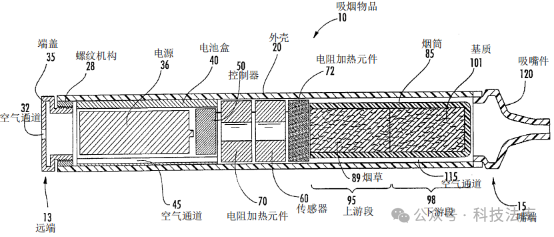
Claim 1 of the 202 patent is as follows:
Feature A: An electrically-powered, aerosol-generating smoking article comprising: an outer housing having two ends; a mouthpiece defined at one of the two ends;
Feature B: an electrical power source arranged within the outer housing; an electrical resistance heater positioned within the outer housing, the electrical resistance heater being configured for electrical connection with the electrical power source
A power source arranged within the outer housing; an electrical resistance heater positioned within the outer housing, the electrical resistance heater being configured for electrical connection with the electrical power source;
Feature C: a storage compartment defined within the outer housing, the storage compartment being configured for storage of a liquid aerosol-forming material and being arranged such that the liquid aerosol-forming material can be wicked into contact with the electrical resistance heater to volatilize the liquid aerosol-forming material;
a storage chamber located within the housing, the storage chamber being configured to store a liquid aerosol-forming substrate and arranged so that the liquid aerosol-forming substrate can contact the resistance heater through wicking to volatilize the liquid aerosol-forming substrate;
Feature D: an air passageway through at least a portion of the outer housing, the air passageway being arranged so that air drawn into the outer housing combines with volatilized liquid aerosol-forming material to produce an aerosol that can be drawn into the mouth of a user of the electrically-powered, aerosol-generating smoking article through the mouthpiece; and
an air passageway through at least a portion of the housing, the air passageway being arranged so that air drawn into the housing combines with volatilized liquid aerosol-forming material to produce an aerosol that can be drawn into the mouth of a user of the electrically-powered, aerosol-generating smoking article through the mouthpiece;
and Feature E: a controller configured to activate current flow through the electrical resistance heater in response to a draw on the electrically-powered, aerosol-generating smoking article through the mouthpiece; article.
A controller configured to respond to suction on an electric, aerosol-generating smoking article to activate a current flowing through a resistive heater.
This case, purely from the perspective of the products and patents involved, is not technically difficult for patent lawyers, but how to consider comprehensive defenses, including invalidation, will undoubtedly be more effective if the e-cigarette litigation and technological development context are clearly understood. Especially in terms of the relationship between the summary of the claims and the embodiments, the clarity of the scope of protection and the issues of implementability, different understanding depths will lead to different views on the issues.
3. Patent invalidation may be a life-saving straw
Renault has many enemies in this lawsuit, and its Patent No. 202 will also become a target of public criticism. If different companies entrust different law firms, and many companies adopt the strategy of invalidation defense, unless a group of lawyers achieves the best invalidation attack, it will only bring fragmented confusion to the judge, that is, the lawyers cannot achieve the simplest and shortest proof path, which will ultimately be counterproductive and make the judge more convinced of the patentability of Patent No. 202.
The most critical feature C+D in Patent No. 202, as long as the lawyer is familiar enough with the technical development of atomization and heating (whether it is HNB or Vapor, they are essentially oxygen-free and non-combustible), the detailed features of different products, simplifying them, and using their spears to attack their shields can achieve results. In addition, from the earliest existing technology of electronic cigarettes, not only the C+D features, but also the claims of the entire Patent No. 202 may not be novel.
Conclusion
Renault's Patent No. 202 337 case, aimed at dozens of companies in various countries, is determined to win. Different from the previous patent litigation with PMI, this time it was commissioned by JONES DAY (Zhongda), a century-old law firm known for litigation. The commission includes not only patent lawyers, but also lawyers in trade supervision. Judging from the content of the application and the cited documents, they have prepared more content in terms of illegal trade, which also makes up for the lack of patent confidence.
Patent litigation in the US e-cigarette market will continue. The Renault Patent Case No. 202 is undoubtedly the most typical example and an opportunity for Chinese e-cigarette companies to fight to the death. If they fail to win the case, Renault will get a taste of the sweetness and pursue the victory, and e-cigarette companies will continue to be passive. Only by turning defeat into victory like the "Hytera Case" can we win the respect and awe of our opponents!
Lawyer introduction:
Tang Shunliang is a partner of Tianyuan Law Firm and has extensive experience in tobacco and e-cigarette law. He has more than ten years of professional experience in patent disputes, legal legislation and compliance. Tang Shunliang has a deep understanding of the technical context and patent situation of tobacco and e-cigarettes, and has successfully handled many compliance issues at home and abroad on behalf of clients, especially in complex cross-patent disputes. In addition, he has long served as a legal advisor to well-known Chinese e-cigarette and tobacco companies.