FDA explains recent regulatory actions to 2Firsts: full-chain supervision and timely introduction of policies to adapt to market changes
Leave a message
FDA explains recent regulatory actions to 2Firsts: full-chain supervision and timely introduction of policies to adapt to market changes
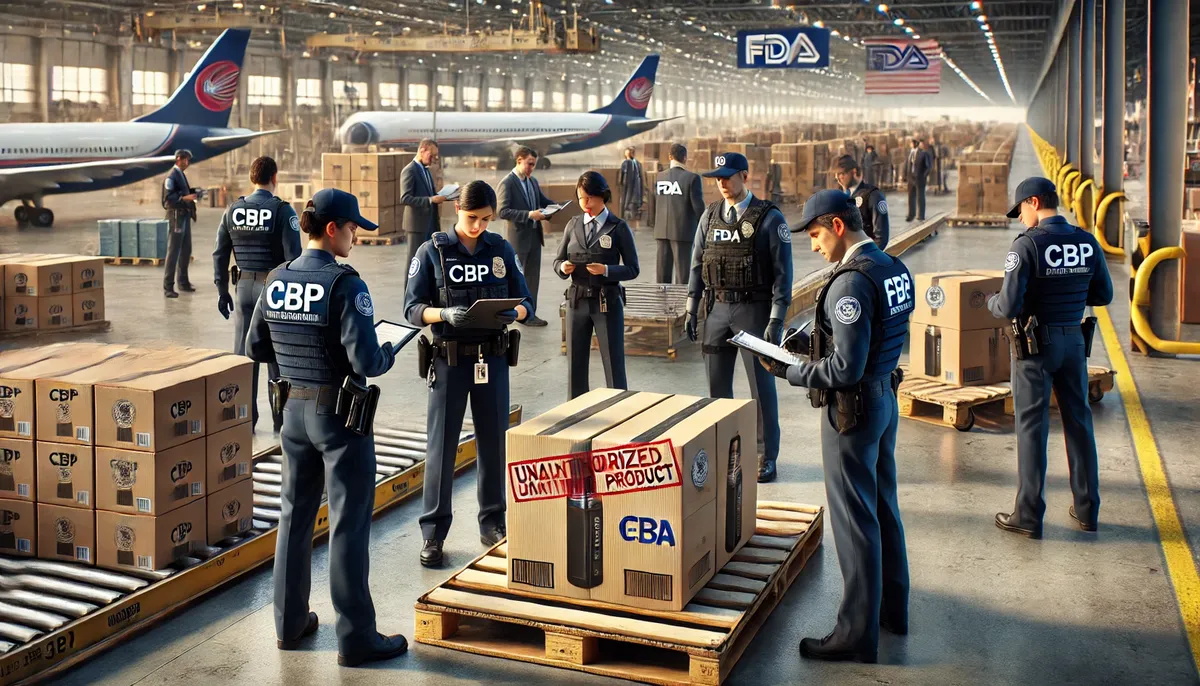
Recently, the US market has seen a number of important regulatory events. The direction of regulation has become a focus of attention for e-cigarette brands and manufacturers in the US market. In order to further understand the policies and enforcement actions, 2Firsts contacted the US FDA. The FDA explained the recent enforcement actions and future plans to 2First2 and provided detailed compliance guidance materials.
Disclaimer:
[1] This article only discusses e-cigarette regulation and business issues, and all content is only for readers in the global new tobacco industry.
[2] This article does not involve analysis and comments on any political or diplomatic issues. All content in this article shall not be cited for political or diplomatic purposes.
[3] The Chinese translation of the relevant US regulatory materials cited in this article is for reference only. All content should be based on the original English text.
Recently, the tightening of regulation in the US e-cigarette market has become a hot topic. On October 22, the FDA announced that it had seized approximately $76 million worth of unauthorized e-cigarette products in conjunction with the U.S. Customs and Border Protection (CBP); on December 4, Congressman Raja Krishnamoorthi issued an investigation letter to several Chinese manufacturers and U.S. wholesalers; on December 5, the FDA, together with state regulators, issued warning letters to 115 retailers that sold illegal e-cigarettes.
This series of regulatory actions has attracted the attention of all parties involved, including U.S. e-cigarette brands, distributors, and Chinese manufacturers. What is the background of the recent regulatory actions of U.S. e-cigarettes, what is the future direction, and how can e-cigarette practitioners more accurately understand the U.S. regulatory policy. With these questions, 2Firsts contacted the U.S. FDA. FDA spokesman Jim McKinney provided 2Firsts with relevant interpretations and information by email.
The primary task: Regulate unauthorized products throughout the entire industry chain, and hold the entire industry chain accountable
Regarding the FDA's next move, Jim McKinney made it clear to 2Firsts:
"Addressing unauthorized tobacco products throughout the entire supply chain is a top priority for the FDA. To do this, the FDA closely monitors retailer, manufacturer, importer, and distributor compliance with federal tobacco laws and regulations and takes regulatory or enforcement action when violations occur. We remain committed to using the full scope of tools in our regulatory toolbox to ensure entities that make, distribute, or sell illegal tobacco products, especially products that appeal to youth, are held accountable."
"Addressing unauthorized tobacco products throughout the entire supply chain is a top priority for the FDA. To do this, the FDA closely monitors retailer, manufacturer, importer, and distributor compliance with federal tobacco laws and regulations and takes regulatory or enforcement action when violations occur. We remain committed to using the full scope of tools in our regulatory toolbox to ensure that those who make, distribute or sell illegal tobacco products, especially products that appeal to youth, are held accountable."
The first key term is the entire supply chain, which is what Jim McKinney emphasized: retailers, manufacturers, importers and distributors. The entities involved in recent regulatory actions do reflect this, including Chinese manufacturers, retailers and wholesalers in the United States, etc. Moreover, he also explicitly proposed to ensure that these entities "can be held accountable" ("are held accountable").
The second key word is - regulatory toolbox. 2Firsts checked the FDA's official website and learned that Jim McKinney's reference to "the full scope of tools in our regulatory toolbox" includes:
Warning letters
Civil money penalties (CMP)
No Tobacco Sales Order Complaints
Import Alerts
Seizures, Injunctions, and Criminal Prosecution
Multi-agency working group to take action against companies trying to evade the law
In the field of regulatory enforcement, the information provided by Jim McKinney to 2Firsts clearly shows the background of the recent acceleration of regulatory actions - a multi-agency working group to combat illegal e-cigarettes:
"In support of this work, multiple federal agencies - including the FDA, the Department of Justice, and U.S. Customs and Border Protection - recently formed a task force to address the illegal distribution and sale of e-cigarettes. The task force aims to coordinate and streamline efforts on illegal e-cigarettes and bring all available criminal and civil tools to bear against companies trying to evade the law. "
"To support this work, multiple federal agencies, including the FDA, the Department of Justice (DOJ), and the U.S. Customs and Border Protection (CBP), recently established a task force to specifically address the distribution and sale of illegal e-cigarettes. The task force aims to coordinate and optimize actions against illegal e-cigarettes and use all available criminal and civil tools to take action against companies trying to evade the law. "
After an inquiry by 2Firsts, Jim McKinney mentioned that the "task force" was established on June 10, 2024. On that day, the U.S. Department of Justice (DOJ) and the U.S. Food and Drug Administration (FDA) announced the establishment of a federal multi-agency task force to combat the illegal distribution and sale of e-cigarettes. It also proposed: The task force will convene multiple law enforcement partners, including the Bureau of Alcohol, Tobacco, Firearms and Explosives (ATF), the U.S. Marshals Service (USMS), the U.S. Postal Inspection Service (USPIS), and the Federal Trade Commission (FTC) to coordinate and streamline efforts to make full use of all available criminal and civil means to combat the illegal distribution and sale of e-cigarettes that target young Americans and lead to nicotine addiction.
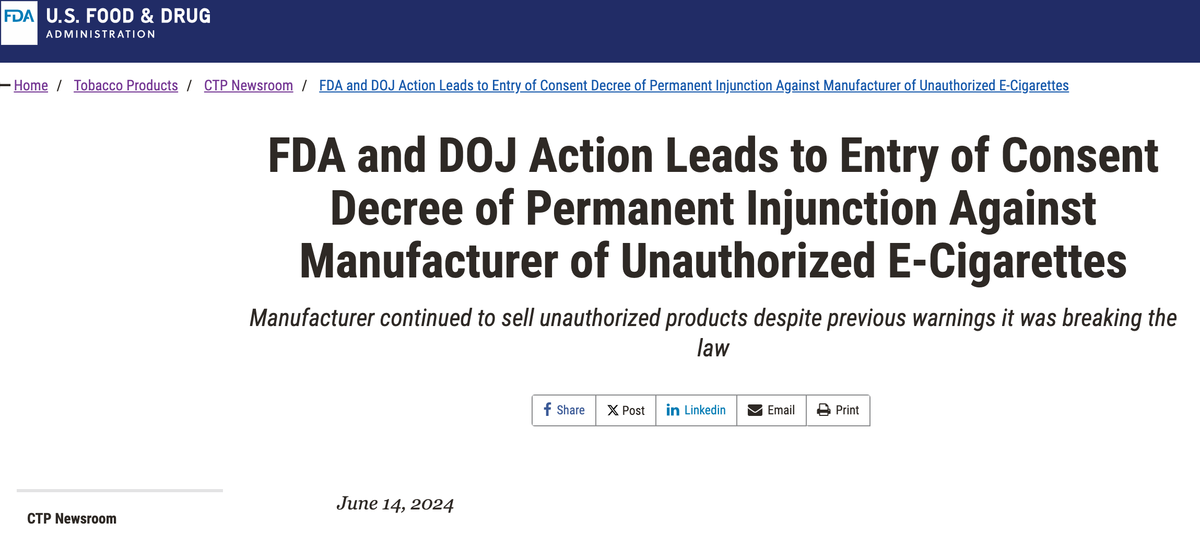
The U.S. Department of Justice (DOJ) and the U.S. Food and Drug Administration (FDA) announced the establishment of a federal multi-agency task force | Source: U.S. FDA
From recent regulatory actions, we can also see the effect of the collaborative work of the "task force". For example, on December 5, the FDA worked with states to issue warning letters to 115 retailers; on October 22, the FDA worked with Customs and Border Protection (CBP) to seize $76 million worth of illegal e-cigarettes. In fact, before the establishment of the "task force", the FDA and CBP had already cooperated in illegal e-cigarette seizures involving large amounts of money. For example, on December 14, 2023, CBP announced that it had seized more than $18 million worth of illegal e-cigarettes.
Timely and influential strategies will be adopted to adapt to market changes
Regarding the future FDA regulation of e-cigarettes, Jim McKinney explained the "5-year strategic plan" to the two supreme 2Firsts, and said that in 2025, efforts will continue based on past progress in achieving the goals, achievements and tasks in the five-year strategic plan. Regarding the goal of strengthening enforcement actions, the FDA will continue to work on:
Provide educational resources that facilitate voluntary compliance by regulated industry;
Pursue timely and impactful compliance and enforcement strategies that adapt to the evolving marketplace; and
Collaborate with other federal and state agencies on compliance and enforcement strategies.
From the above, it can be clearly seen that in 2025, the FDA's work will be reflected in three aspects: strengthening compliance education, adapting to market changes, and strengthening multi-departmental collaboration.
The five-year strategic plan was released by CTP on December 18, 2023. In the article titled "A Year in Review: Progress of the U.S. Food and Drug Administration in Tobacco Product Regulation in 2023", Brian King, director of the CTP Center, listed the five-year strategic plan as one of the important milestones in 2023.
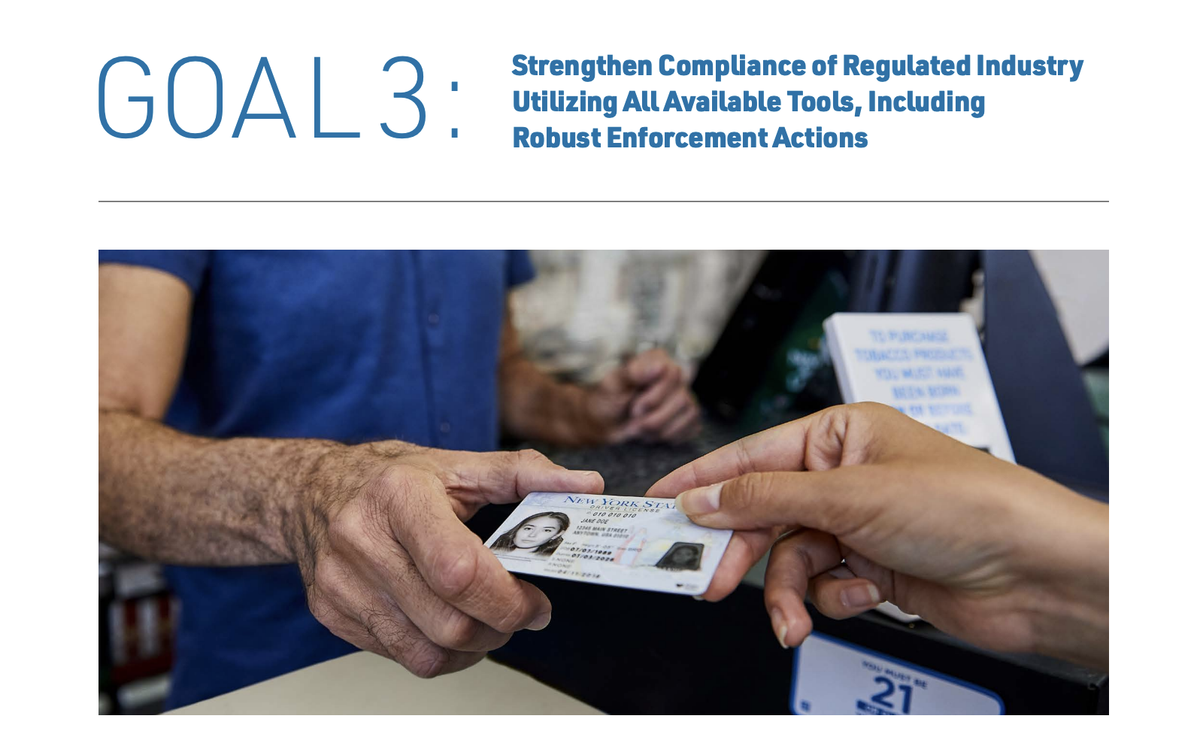
Five-year strategic plan goals | Source: U.S. FDA
Five major goals are set in the five-year strategic plan, among which the goal for compliance enforcement is to strengthen compliance management of regulated industries by making full use of all available tools (including strong enforcement actions). Specific results include: "Illegal tobacco products that attract teenagers, especially illegal products, will no longer appear on the market"; and "regulated industries understand how to comply with the law."
FDA provides compliance information and resources to e-cigarette companies in a variety of ways
2Firsts reflected to the FDA the compliance difficulties currently faced by e-cigarette companies, namely: many companies do not understand the U.S. e-cigarette regulatory policies and future trends, including PMTA, very well, and it is difficult to make timely and effective compliance actions. Jim McKinney told 2Firsts:
The premarket review process remains a cornerstone of the FDA's efforts, and we continue to work with regulated industry to provide information and resources. These resources include a webpage of PMTA tips, public meetings, scientific memos, and webinars.
"The premarket review process remains a cornerstone of the FDA's efforts, and we continue to work with regulated industry to provide information and resources. These resources include a webpage of PMTA tips, public meetings, scientific memos, and webinars. "
Jim McKinney also provided 2Firsts with detailed examples of relevant compliance education resources and links to web resources:
PMTA Tips: Based on the FAQs, FDA lists the necessary forms and provides suggestions for filling them out to help applicants complete them correctly – FDA Tobacco Product Application Tips – Premarket Tobacco Product Application.
Public Meeting: In October 2023, the FDA held a public meeting on the application review process to reaffirm its commitment to transparency and provide an opportunity for stakeholders to engage, with the goal of improving public understanding of the review process – Premarket Applications: Stakeholder Engagement Opportunities – Public Meeting – October 23, 2023.
Memos: The FDA has issued several scientific review policy memos that provide an overview of the FDA's internal thinking on certain topics in the premarket tobacco product review process. These memos increase transparency and reveal what different regulatory science disciplines consider when reviewing tobacco product applications – Regulatory Science Policy Memos.
Webinars: The FDA has hosted a series of webinars and videos on federal tobacco regulations to provide compliance education and information for retailers, small manufacturers, and importers – FDA Tobacco Compliance Webinars.
FDA Searchable Tobacco Products Database: The FDA's database-accessible at www.fda.gov/searchtobacco-provides information on legally marketed tobacco products. The FDA also maintains a one-page printable brochure that lists FDA-authorized e-cigarette products.
In addition to the above resources, CTP's Office of Small Business Assistance can also answer specific questions about small business requirements and how to comply with regulations. The office also provides online educational resources to help regulated industries understand FDA regulations and policies.
Jim McKinney emphasized:
The FDA's Center for Tobacco Products is open to continued opportunities to further educate and engage with stakeholders, including regarding the PMTA process.
FDA's Center for Tobacco Products is open to continued opportunities to further educate and engage with stakeholders, including regarding the PMTA process.